Urgent: call within days
1. Fungal conks on the trunk or root flare
Shelf-like brackets or clusters of mushrooms growing directly out of the trunk or from the root flare are fruiting bodies of decay fungi. By the time they appear on the outside, the decay inside has usually been advancing for years.
This is the sign homeowners most often dismiss, because the tree above may still look green and full. A tree can hold a full crown while structurally hollow at the base.
2. A vertical crack in the main stem
A crack running up and down the trunk means the wood has already begun to separate. Under wind load it will keep going. Cracks at a branch union are equally serious.
3. A new lean, with soil lifting
The word new is doing all the work here. A tree that has leaned for twenty years, with straight taper and undisturbed ground at the base, is usually fine. A tree that has started leaning recently, with soil cracked or heaved on the side opposite the lean, has a root plate coming out of the ground. Treat that as an emergency, particularly after heavy rain.
4. More than half the crown dead
A tree that failed to leaf out across a large share of its canopy this spring is in serious trouble. Beyond roughly 50% crown loss, recovery is unlikely and the dead portion is a growing hazard.
Worth an assessment soon
5. Bark falling away in sheets
Healthy bark is firmly attached. Bark sloughing off in plates, exposing smooth dead wood underneath, means the cambium in that section has died. In Central Texas this frequently accompanies hypoxylon canker, which follows drought stress and typically indicates a tree already in decline.
6. Deadwood accumulating year on year
All trees shed some deadwood. What matters is the trend. If each summer produces noticeably more dead limbs than the last, and they are getting larger, the tree is losing the ability to support its own canopy.
7. Leafing out late, sparsely, or with undersized leaves
A stressed tree produces smaller, paler, thinner foliage and comes into leaf later than its neighbours. This is a symptom, not a diagnosis. The cause might be root damage, compaction, drought, girdling roots, disease, or simply that somebody changed the irrigation two years ago.
Signs that look alarming but usually are not
- Surface roots. Normal, especially on the thin limestone soils west of Mopac. Do not bury them under fill, which suffocates them.
- Sap or ooze from a small wound. Often just the tree responding to injury.
- Autumn leaf drop out of season. Central Texas trees frequently shed early in a drought summer as a water-saving measure.
- Lichen on the bark. Lichen is not a parasite. It grows on the surface and takes nothing from the tree. It is more visible on thin canopies, which is why people associate it with sick trees.
- A hollow that a squirrel lives in. Depends entirely on how much sound wood remains around it. Trees compartmentalise decay, and a hollow trunk with a thick sound shell can be perfectly stable. That judgement needs measurement, not a guess.
What an assessment actually involves
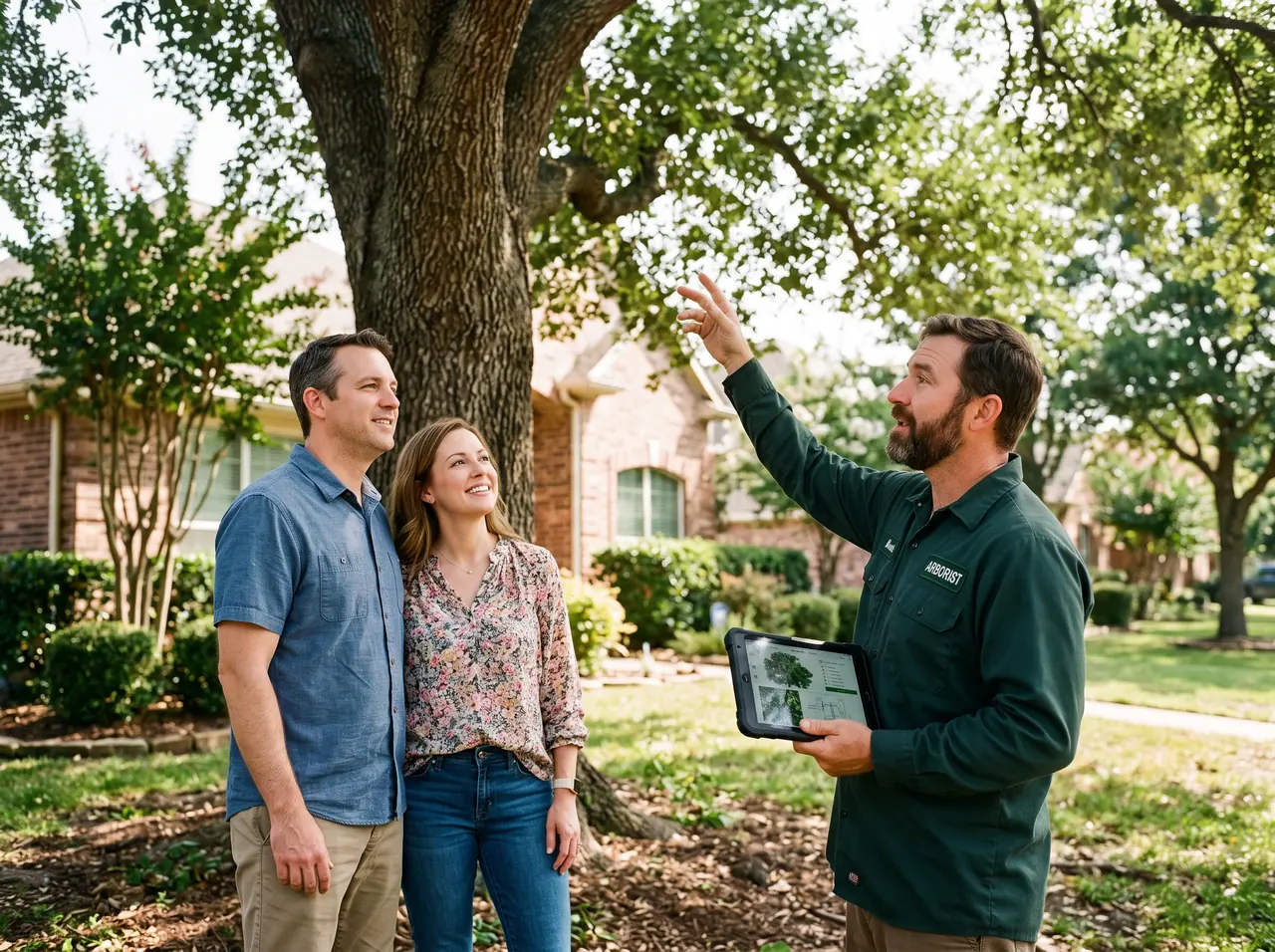
A Level 2 basic assessment is a systematic 360-degree ground inspection covering the root flare, trunk, branch unions and crown. Where internal decay is suspected, resistance drilling measures how much sound wood actually remains, which turns a guess into a number.
The result is a defined risk rating combining three things: how likely the tree is to fail, how likely it is to hit something if it does, and how bad that would be. A dead tree in the middle of a paddock is low risk. A partially decayed tree over a child bedroom is not.
Removal is not the only outcome
A large share of the assessments we carry out conclude that the tree is retainable. Options short of removal include crown reduction to cut leverage, cabling or bracing a weak union, treating a diagnosed disease, correcting drainage or compaction, or simply moving the target: relocating the parking space rather than removing the oak.
Get the diagnosis before you get the quote.