Greater Austin coverage
Ten cities. Four soil types. One crew.
We work Greater Austin and its suburbs with no travel surcharge. Each city page covers the local soil, species and permit rules, because they change the work more than most people expect.
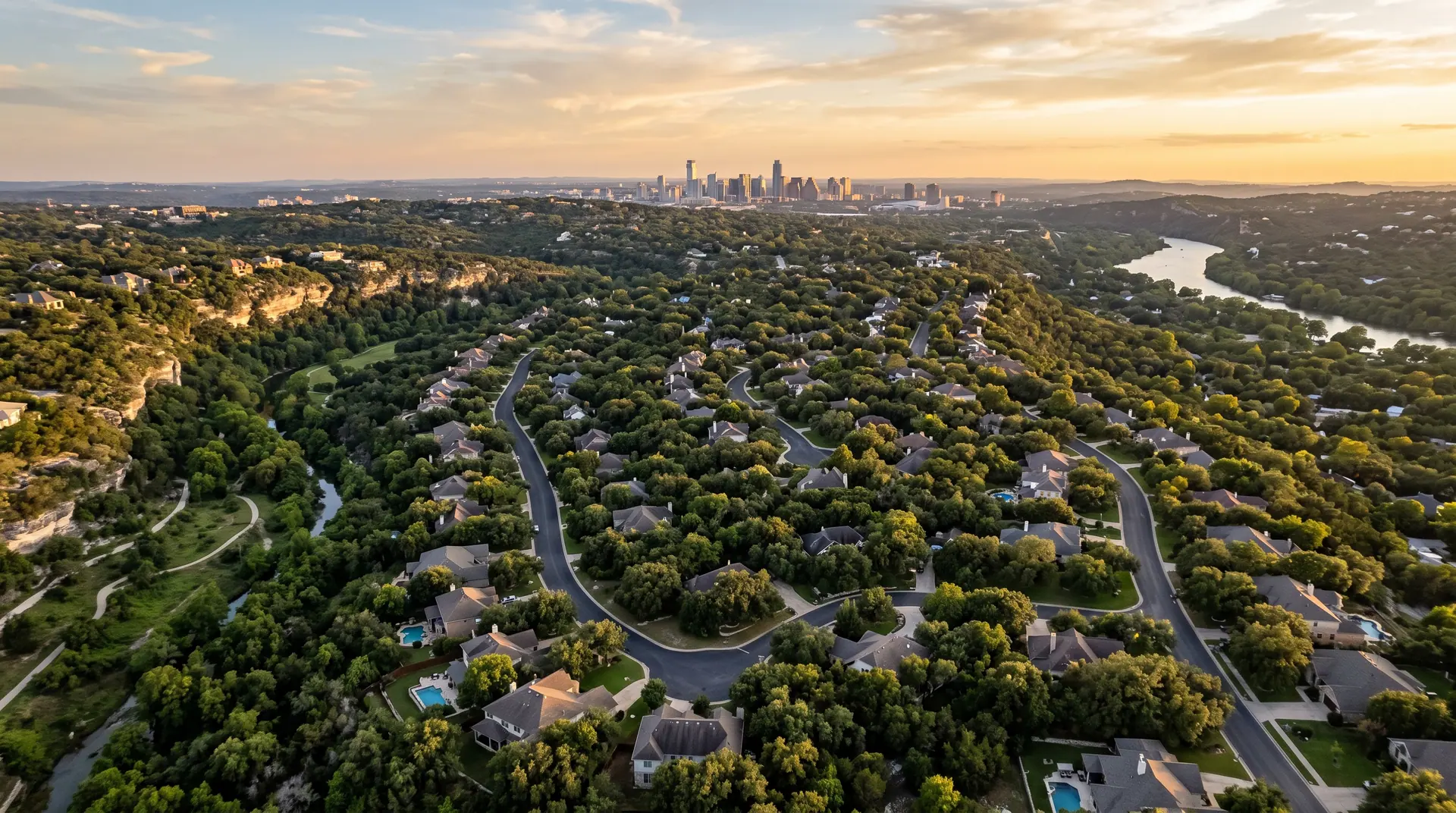
- AustinTravis CountyUnder 2 hours for emergenciesLive oakPost oakCedar elm
- Round RockWilliamson County2 to 3 hours for emergenciesCedar elmLive oakPecan
- Cedar ParkWilliamson County2 to 3 hours for emergenciesAshe juniperLive oakCedar elm
- GeorgetownWilliamson County3 to 4 hours for emergenciesPecanLive oakBur oak
- PflugervilleTravis County2 to 3 hours for emergenciesCedar elmLive oakHackberry
- LeanderWilliamson County3 hours for emergenciesAshe juniperLive oakTexas red oak
- LakewayTravis County3 to 4 hours for emergenciesAshe juniperLive oakTexas red oak
- Dripping SpringsHays County3 to 4 hours for emergenciesLive oakAshe juniperTexas red oak
- KyleHays County3 hours for emergenciesLive oakCedar elmPecan
- BudaHays County2 to 3 hours for emergenciesLive oakCedar elmAshe juniper
Local knowledge
Why the ground under your tree changes the advice
Edwards Plateau limestone
Cedar Park, Leander, Lakeway, Dripping Springs, west Austin
Thin soil over solid rock. Roots run wide and shallow because there is nowhere deep to go, which makes trees unusually sensitive to compaction, grade changes and drought. Stump grinding also runs slower and wears teeth faster here.
Blackland Prairie clay
Pflugerville, Kyle, east Round Rock, east Buda
Deep expansive clay that shrinks in drought and swells with rain. That movement tears fine roots and stresses trees, which is why limbs so often fail in the first heavy storm after a dry spell. It also raises real questions about large trees near a slab.
River and creek bottomland
San Gabriel, Onion Creek, Brushy Creek, Plum Creek
Deeper, richer, periodically saturated soil that grows much larger pecans, bur oaks and sycamores. Bigger trees mean heavier deadwood loads and a shorter inspection cycle, plus root rot problems upland trees never see.
At a glance
Response times by city
| City | County | Emergency response | Zip codes |
|---|---|---|---|
| Austin | Travis County | Under 2 hours for emergencies | 78701, 78704, 78745, 78749, 78735, 78703, 78731, 78751, 78702, 78741 |
| Round Rock | Williamson County | 2 to 3 hours for emergencies | 78664, 78665, 78681 |
| Cedar Park | Williamson County | 2 to 3 hours for emergencies | 78613, 78630 |
| Georgetown | Williamson County | 3 to 4 hours for emergencies | 78626, 78628, 78633 |
| Pflugerville | Travis County | 2 to 3 hours for emergencies | 78660, 78691 |
| Leander | Williamson County | 3 hours for emergencies | 78641, 78645 |
| Lakeway | Travis County | 3 to 4 hours for emergencies | 78734, 78738 |
| Dripping Springs | Hays County | 3 to 4 hours for emergencies | 78620, 78737 |
| Kyle | Hays County | 3 hours for emergencies | 78640 |
| Buda | Hays County | 2 to 3 hours for emergencies | 78610 |
Questions
Service area questions
What areas does Summit Tree Care serve?
Greater Austin and the surrounding suburbs: Austin, Round Rock, Cedar Park, Georgetown, Pflugerville, Leander, Lakeway, Dripping Springs, Kyle and Buda, plus Bee Cave, Hutto, Manor and Rollingwood. All are inside our standard service area with no travel surcharge.
Do you charge extra for travel outside Austin?
No. Every city listed on this page is inside our standard service area, and on-site estimates are free everywhere in it. For work well beyond that footprint we will tell you up front that mobilisation is part of the scope rather than folding it in quietly.
How fast can you reach an emergency outside Austin?
Buda and Pflugerville are typically two to three hours, Round Rock and Cedar Park two to three, Leander and Kyle about three, and Georgetown, Lakeway and Dripping Springs three to four. After a widespread regional storm every crew is committed at once, so we triage by severity and tell you honestly where you sit in the queue.
Why do you have a separate page for each city?
Because the work genuinely differs. Cedar Park sits on shallow limestone, Pflugerville on deep expansive clay, and Buda straddles both. Austin and Georgetown operate tree ordinances that Round Rock and Kyle do not. Advice that ignores those differences is worth very little.
Have someone stand under it first.
An arborist will walk your property, say plainly what each tree needs, and put the whole scope in writing before anything is agreed. If the answer is that it needs nothing, that is the answer you get.
- Free on-site visit, usually within 2 to 3 days
- Every tree named in writing before we start
- No obligation and no pressure to book