Greater Austin
Tree Health & Oak Wilt Management
Diagnosis and treatment for oak wilt, decline and pests, from the people who see it every week.
- Standard
- Diagnosis before treatment
- Booking
- 5 to 8 days
- Emergencies same day
- Estimate
- Free on site
- No obligation
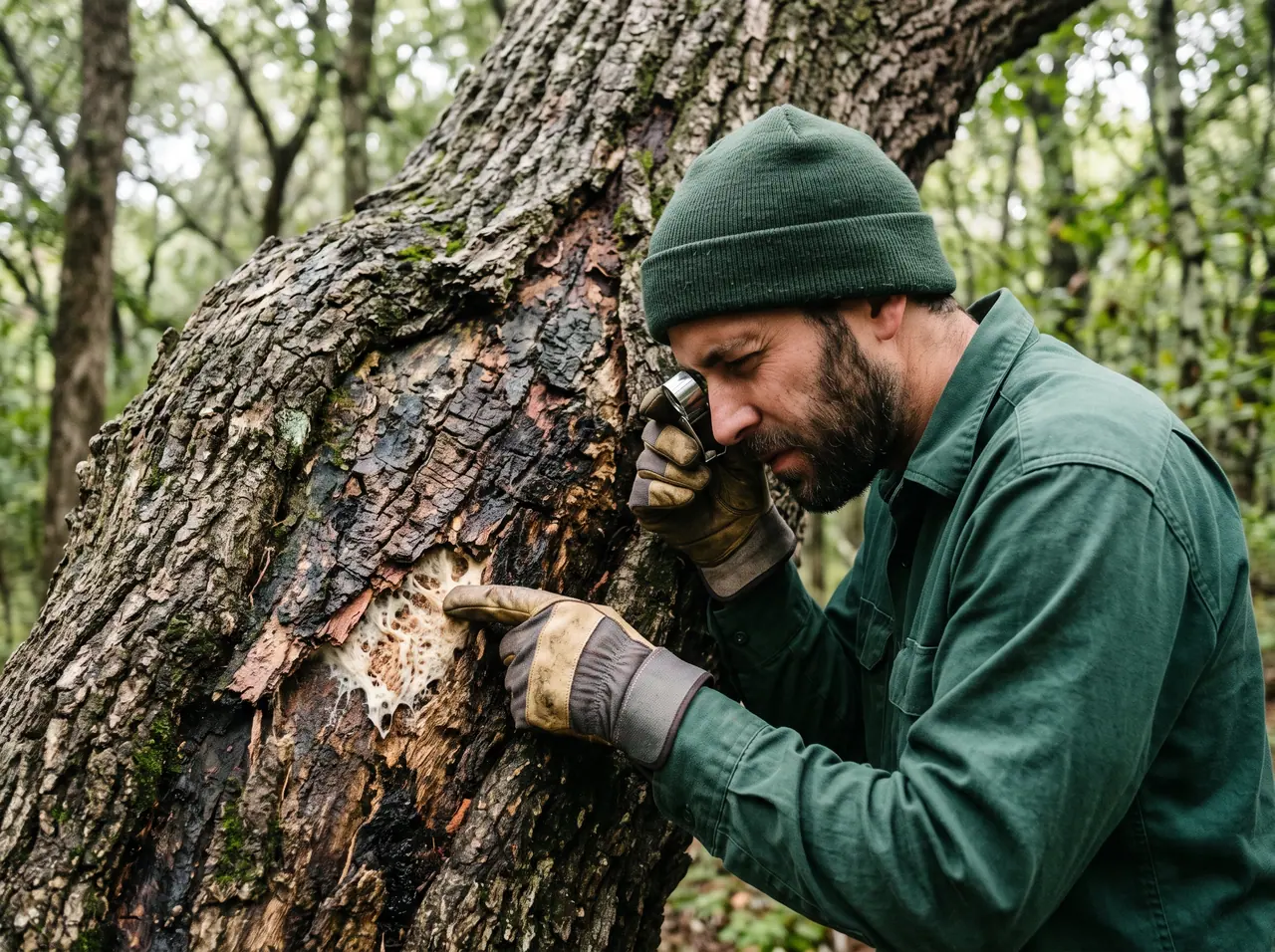
Oak wilt has killed more live oaks in Central Texas than any storm ever has. It moves in two ways. Underground, it travels through the grafted root systems that connect neighbouring live oaks into a single organism, which is why it advances across a street tree by tree in a visible front. Above ground, it is carried by tiny sap-feeding beetles drawn to fresh wounds, which is why the pruning calendar matters so much here.
The early symptoms are specific and easy to miss. Live oak leaves develop veinal necrosis, where the veins themselves turn yellow then brown while the tissue between them stays green a little longer. Red oaks behave differently and often die fast, sometimes holding their brown leaves through winter. By the time a homeowner notices thinning in the crown, the fungus has usually been present for a while.
Not every declining oak has oak wilt. Hypoxylon canker, root rot, construction damage, girdling roots and simple drought stress all look similar from the driveway. Getting the diagnosis right first is the entire job, because the treatments have nothing in common.
What is included
- Field diagnosis
- An arborist examines leaf symptoms, crown pattern, the spread across neighbouring trees and the root flare, and takes samples for lab confirmation where the picture is unclear.
- Propiconazole macro-infusion
- Fungicide injected directly into the vascular system through the root flare, which protects healthy high-value oaks and can slow decline in lightly affected ones.
- Root trenching
- A trench cut four feet deep along a mapped line to sever the grafted roots carrying the fungus toward unaffected trees.
- Correct disposal of infected wood
- Red oak material that can produce fungal mats removed and disposed of properly rather than stacked as firewood, which is a common way outbreaks restart.
- Deep-root fertilisation
- Soil-injected nutrition placed in the root zone to support recovery in stressed trees, based on what the soil actually lacks.
- Written management plan
- A plan covering which trees to inject, where to trench, what to remove and when you can safely prune, with a follow-up schedule.
How we approach it
- 1
Inspect and identify
Symptoms, pattern of spread and site history assessed on the ground, with laboratory sampling where confirmation is needed.
- 2
Map the spread
We plot which trees are affected and which are at risk, which determines where a trench line has to run to do any good.
- 3
Treat and separate
High-value healthy oaks injected, trench cut where indicated, and infected material removed and disposed of correctly.
- 4
Monitor
Follow-up inspections through the season, with re-injection typically every 18 to 24 months for trees under ongoing pressure.
Before we quote
What shapes the work
Nobody can scope this accurately over the phone, and any company that tries is guessing. These are the five things an arborist is actually assessing when they walk your property.
- Trunk diameter
- Injection is dosed on trunk diameter, so a 36 inch live oak takes considerably more product and time to treat than an 18 inch one.
- Number of trees
- Treating a group in one visit is far more efficient than treating one tree at a time, since setup and mobilisation are shared.
- Trench length and obstacles
- Trenching is measured by the foot, and slows sharply where the line has to cross driveways, irrigation, utilities or limestone.
- Stage of infection
- Injection protects healthy trees well. A tree already showing significant crown loss is a much poorer candidate and we will say so.
- Access for equipment
- Trenching requires machinery on site. Restricted back-yard access can mean hand work instead, which changes the job substantially.
Questions
Tree Health & Oak Wilt Management questions
What is oak wilt and how does it spread in Austin?
Oak wilt is a lethal vascular disease caused by the fungus Bretziella fagacearum. It spreads two ways in Central Texas: underground through the interconnected root systems that link neighbouring live oaks, and above ground by sap-feeding nitidulid beetles that carry spores from fungal mats on dead red oaks to fresh wounds on healthy trees. Roughly 90% of local spread is through roots.
When should I avoid pruning oaks in Central Texas?
Avoid pruning oaks from February through June, the period when sap-feeding beetles are most active and most strongly attracted to fresh wounds. July through January is the safer window. If storm damage forces an emergency cut during spring, paint every wound immediately, within minutes rather than hours.
Can a tree with oak wilt be saved?
Sometimes, depending on species and stage. Live oaks showing early symptoms can respond to propiconazole injection, and some survive with reduced crowns. Red oaks rarely survive once symptoms appear and generally die within weeks to months. Injection is most valuable as protection for healthy high-value trees near a known infection centre, rather than as a rescue for a tree already in steep decline.
What does oak wilt treatment actually involve?
Three things, usually together. Macro-infusion injection puts propiconazole into the vascular system through the root flare, dosed on trunk diameter, and needs repeating roughly every 18 to 24 months while pressure continues. Trenching cuts a line four feet deep to sever the grafted roots carrying the fungus toward healthy trees. Infected red oak material is removed and disposed of properly so it cannot produce fungal mats. We map all three onto your property in a written plan after inspection.
Should I stop using oak firewood?
Be careful with it. Red oak that died of oak wilt can produce spore-bearing fungal mats under the bark, and stacking that wood next to healthy trees is a genuine way to start a new infection centre. Do not move unseasoned red oak firewood between properties. If you already have some, keep it fully covered with clear plastic sealed at the ground until it is thoroughly seasoned.
Often needed alongside
Tree Trimming & Pruning
Structural pruning that improves the health of the tree instead of just making it smaller.
Read moreArborist Consulting & Risk Assessment
Written, defensible assessments for permits, construction, disputes and insurance.
Read moreCabling & Bracing
Hardware support that keeps a structurally weak but otherwise healthy tree standing.
Read moreTree Health & Oak Wilt Management across Greater Austin
We carry out this work in every city we serve, with no travel surcharge. Local soil, species and permit rules differ, so each city page covers what actually changes.
Ready to book tree health & oak wilt management?
A free on-site visit from an arborist, the whole scope agreed in writing before we start, and complete cleanup when we finish.
- Free on-site visit, usually within 2 to 3 days
- Every tree named in writing before we start
- No obligation and no pressure to book