Greater Austin
Tree Removal
Technical, piece-by-piece removal of trees that cannot be saved, including work over roofs and pools.
- Standard
- Permit handled
- Booking
- 5 to 8 days
- Emergencies same day
- Estimate
- Free on site
- No obligation
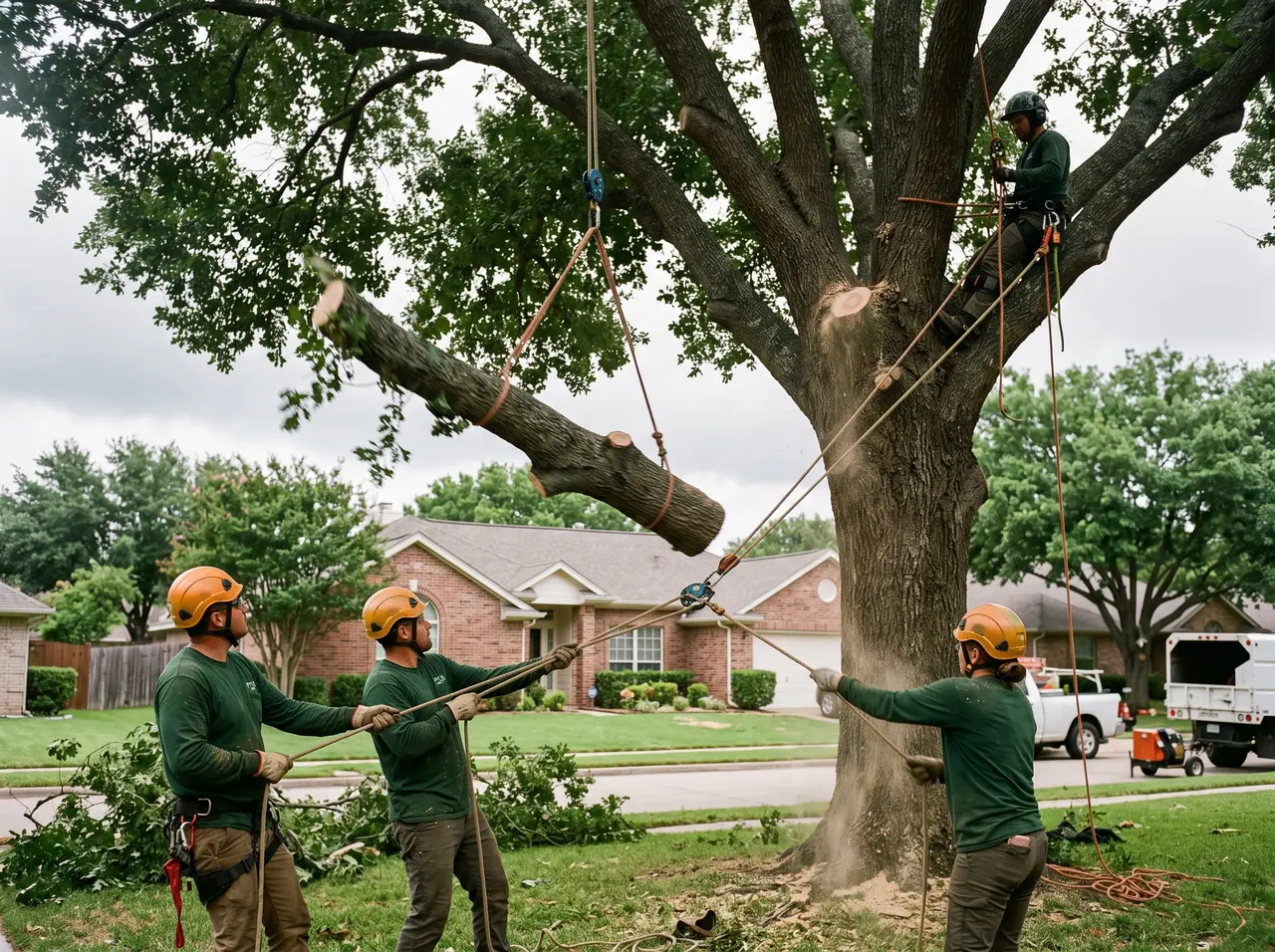
Removing a tree is the last option, not the first. A healthy tree adds real value to an Austin property, shades a roof through August, and takes decades to replace. Before we quote a removal we will tell you honestly whether pruning, cabling or treatment would solve the problem instead.
When a tree does have to come down, how it comes down matters enormously. A tree in an open field can be felled in one piece. A tree eight feet from a bedroom wall has to be dismantled from the top, one section at a time, with each piece roped and lowered under control. That is slower, it requires a climber who knows what a compromised trunk feels like under load, and it is why no two removals are really the same job.
Before you hire anyone for removal work, ask for a certificate of insurance sent to you directly by the insurer, naming general liability and workers compensation. Ask us, and ask everyone else you get a quote from. In this trade it is not a formality: an uninsured crew injured in your yard can become your problem.
What is included
- Full risk assessment
- An arborist evaluates trunk integrity, lean, decay and drop zones before anyone climbs, and sets the removal method accordingly.
- Permit handling
- Austin protects trees 19 inches in diameter and larger, and Heritage trees at 24 inches. We identify whether yours is protected and file the paperwork.
- Technical rigging
- Limbs and trunk sections lowered on rope and friction device rather than dropped, so nothing lands on a roof, fence, pool or garden bed.
- Property protection
- Plywood and mats laid over driveways and lawns where heavy sections land or equipment tracks across.
- Complete debris removal
- Everything chipped and hauled. Firewood cut to length and stacked on site instead if you would rather keep it.
- Optional stump grinding
- Ground 6 to 10 inches below grade the same day, with grindings raked out and the hole backfilled ready for turf.
How we approach it
- 1
Assess and permit
We confirm the tree genuinely needs removal, measure diameter at breast height to check protected status, and file any required City permit.
- 2
Set up and protect
Drop zones marked, property protection laid, and the crew briefed on the rigging plan before a saw is started.
- 3
Dismantle from the top
The climber removes the crown in sections, then steps the trunk down in controlled lengths, each one lowered rather than dropped.
- 4
Grind and restore
Stump ground if selected, grindings removed, site raked and blown clean, and the finished area walked with you.
Before we quote
What shapes the work
Nobody can scope this accurately over the phone, and any company that tries is guessing. These are the five things an arborist is actually assessing when they walk your property.
- Height and trunk diameter
- The work climbs sharply with size. A 30-foot tree is a morning. An 80-foot live oak with a four-foot trunk is a full day for a full crew.
- What is underneath
- Open lawn is straightforward. A tree over a pool, a screened porch or a neighbour fence requires slow, precise rigging on every single piece.
- Equipment access
- If the chipper and truck can reach the tree, the job moves quickly. If everything must be carried 200 feet through a side gate, labour hours multiply.
- Tree condition
- Counterintuitively, a badly decayed tree is often the harder job. A climber cannot trust a hollow trunk, so the work may need a crane instead.
- Permit requirements
- Protected and Heritage trees require an application, sometimes an arborist report, and occasionally mitigation planting.
Questions
Tree Removal questions
Do I need a permit to remove a tree in Austin?
Often, yes. The City of Austin protects trees 19 inches or more in diameter measured at 4.5 feet above ground, and designates Heritage trees at 24 inches and above for certain species including live oak, pecan and bald cypress. Removing a protected tree without a permit can bring significant fines. We measure your tree and handle the application as part of the job.
What decides how big a job my removal is?
Four things, in roughly this order: how tall the tree is and how thick the trunk is, what sits underneath it, whether the chipper and truck can reach it, and what condition the wood is in. A small ornamental in an open yard is a morning. A mature live oak overhanging a bedroom is a full day of rigged, sectional work. An arborist walks the tree with you and puts the whole scope in writing before anyone starts.
Does my homeowners insurance cover tree removal?
Usually only when the tree has already fallen and damaged an insured structure. Most policies will not pay to remove a standing tree, even a clearly hazardous one, and many will not pay to remove a fallen tree that hit nothing. Check your specific policy. We provide itemised documentation and photographs for claims at no extra charge.
Is stump grinding included in a removal?
Not automatically, because not everyone wants it. Some people are replanting, some are laying a patio, and some are happy to leave it. We always include it as an option in the written scope so you can decide, and doing both on the same visit takes far less time than bringing the grinder back separately.
How long does a removal take?
A straightforward small tree is two to three hours. A mature oak over a house is typically a full day. Very large crane removals occasionally run into a second day. We give you a realistic window with the written scope and tell you where the crew needs to park.
Often needed alongside
Stump Grinding & Removal
Grinding well below grade so you can replant, re-turf or build over the spot without a callback.
Read moreCrane-Assisted Tree Removal
For trees too large, too dead or too close to the house to dismantle safely on rope alone.
Read more24/7 Emergency Storm Damage
A real crew on the phone at 3am, not an answering service. Trees off houses, driveways cleared.
Read moreTree Removal across Greater Austin
We carry out this work in every city we serve, with no travel surcharge. Local soil, species and permit rules differ, so each city page covers what actually changes.
Ready to book tree removal?
A free on-site visit from an arborist, the whole scope agreed in writing before we start, and complete cleanup when we finish.
- Free on-site visit, usually within 2 to 3 days
- Every tree named in writing before we start
- No obligation and no pressure to book