The honest ranges
For Greater Austin, in 2026:
| Situation | Typical cost |
|---|---|
| Small ornamental, open yard, under 25 feet | $650 to $950 |
| Medium tree, 25 to 50 feet, some rigging | $950 to $1,600 |
| Mature live oak, 50 to 70 feet, near structures | $1,200 to $2,400 |
| Large oak or pecan, over 70 feet, heavy rigging | $2,000 to $3,200 |
| Crane-assisted removal | $2,400 to $9,500 |
| Stump grinding, added separately | $145 to $600 |
These are Austin numbers, not national averages. National calculators are consistently low for this market because they do not account for how much of the local canopy is mature live oak growing very close to houses.
The five things that move the number
1. Height and trunk diameter
Cost climbs steeply rather than linearly with size. A tree twice as tall has far more than twice the volume of wood, and every piece has to be cut, rigged, lowered, dragged, chipped and hauled.
2. What is underneath
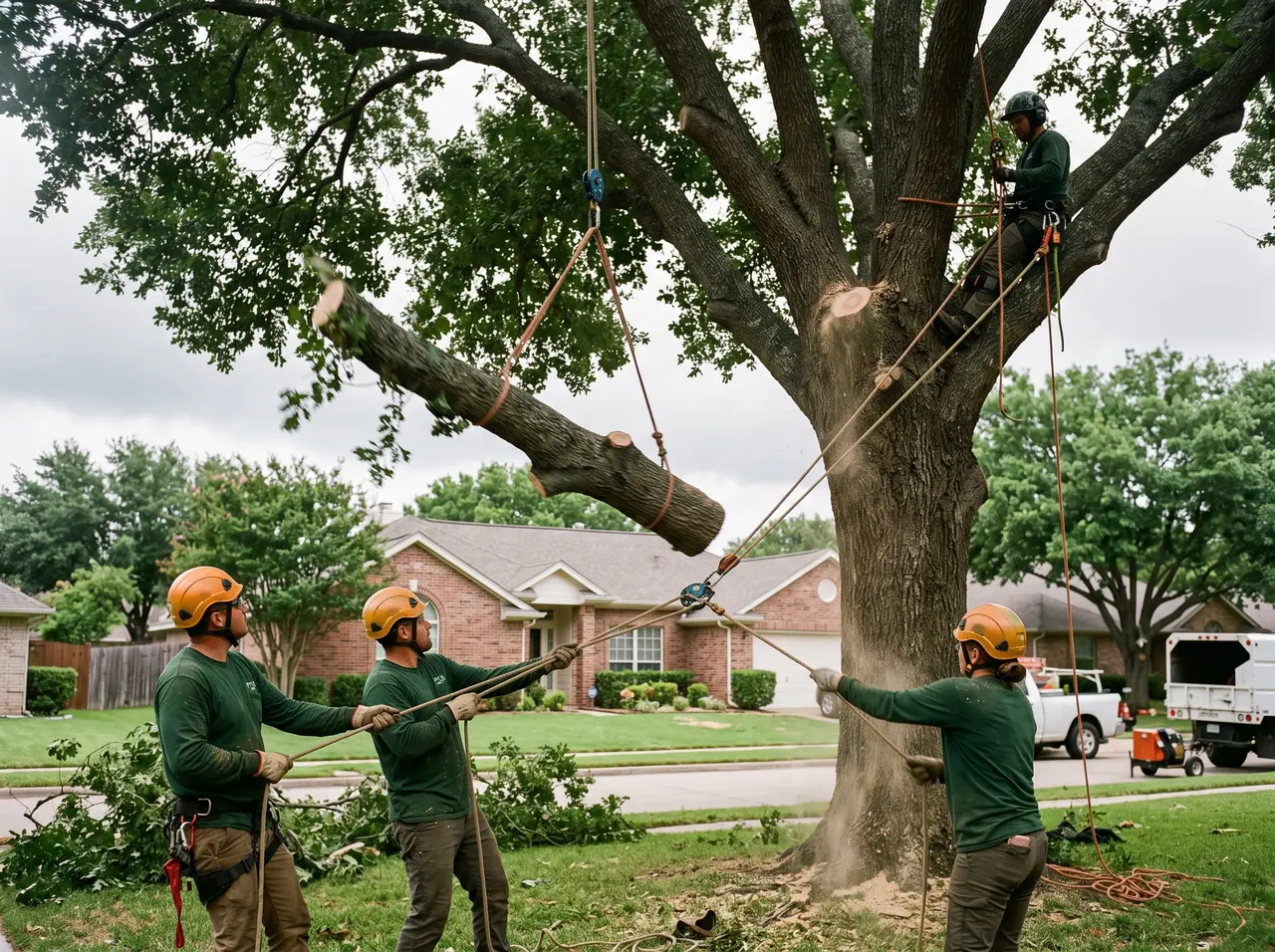
This is the factor most homeowners underestimate. A tree in open lawn can have limbs dropped straight down, which is fast. A tree over a pool, a screened porch, a neighbour fence or a bed of expensive plantings needs every single piece roped and lowered under control. The same tree in two locations can differ by 60% in price.
3. Access
If the chipper and truck can park beside the tree, material flows straight from cut to chipper. If everything has to be carried 200 feet through a 36 inch side gate, labour hours multiply. Back-yard trees with no gate access are the most expensive removals per foot of tree.
4. The condition of the trunk
Counterintuitively, a badly decayed tree usually costs more than a healthy one of the same size. A climber cannot trust a hollow trunk to hold an anchor. That either means working from an aerial lift, which needs access, or bringing in a crane, which changes the price bracket entirely.
If a company quotes a visibly rotten tree at the same rate as a sound one, ask how they plan to climb it.
5. Permits
Inside Austin city limits this is a real cost and a real timeline. The City protects trees measuring 19 inches or more in diameter at 4.5 feet above grade, and designates qualifying species at 24 inches and above as Heritage trees, which face a considerably more involved review.
Removing a protected tree without approval can bring fines running into thousands of dollars. Williamson and Hays County jurisdictions are generally lighter, though Georgetown operates its own ordinance and HOA covenants apply widely.
What insurance actually covers
The common assumption is that homeowners insurance covers hazardous trees. It generally does not.
Most Texas policies cover removal only after a tree has fallen and damaged an insured structure, and often only the portion of the tree affecting that structure, commonly up to a sublimit around $500 to $1,000. A tree that fell and hit nothing is frequently not covered at all. A standing tree, however obviously dangerous, is almost never covered.
That asymmetry is worth thinking about. Paying $1,800 to remove a failing oak before it comes down is cheaper than the deductible on the roof claim afterwards.
Reading a quote properly
Compare like for like. A quote should state:
- Which specific trees, identified clearly
- Whether debris is chipped and hauled, or left on site
- Whether the stump is included, and to what depth
- Who files any required permit and who pays the fee
- Proof of general liability and workers compensation
- Whether it is a fixed price or an hourly rate
That workers compensation line is the one people skip. If an uninsured climber is injured in your yard, the claim can find its way to your homeowners policy. Ask for the certificate to be sent to you directly by the insurer, not handed over as a photocopy.
When removal is not the answer
Before agreeing to a removal, it is worth asking whether the actual problem has a cheaper solution:
- A structurally weak union may be cabled for $450 to $1,600 rather than removed for $2,400
- A tree crowding a roof may need clearance pruning, not removal
- A declining oak may have a treatable disease rather than a terminal one
- A tree in the way of construction may be protectable with a tree protection plan
A mature shade tree measurably reduces summer cooling costs and adds to property value. Twenty years is a long time to wait for a replacement to do the same job.